Understanding the System
What Is Borewell Recharge?
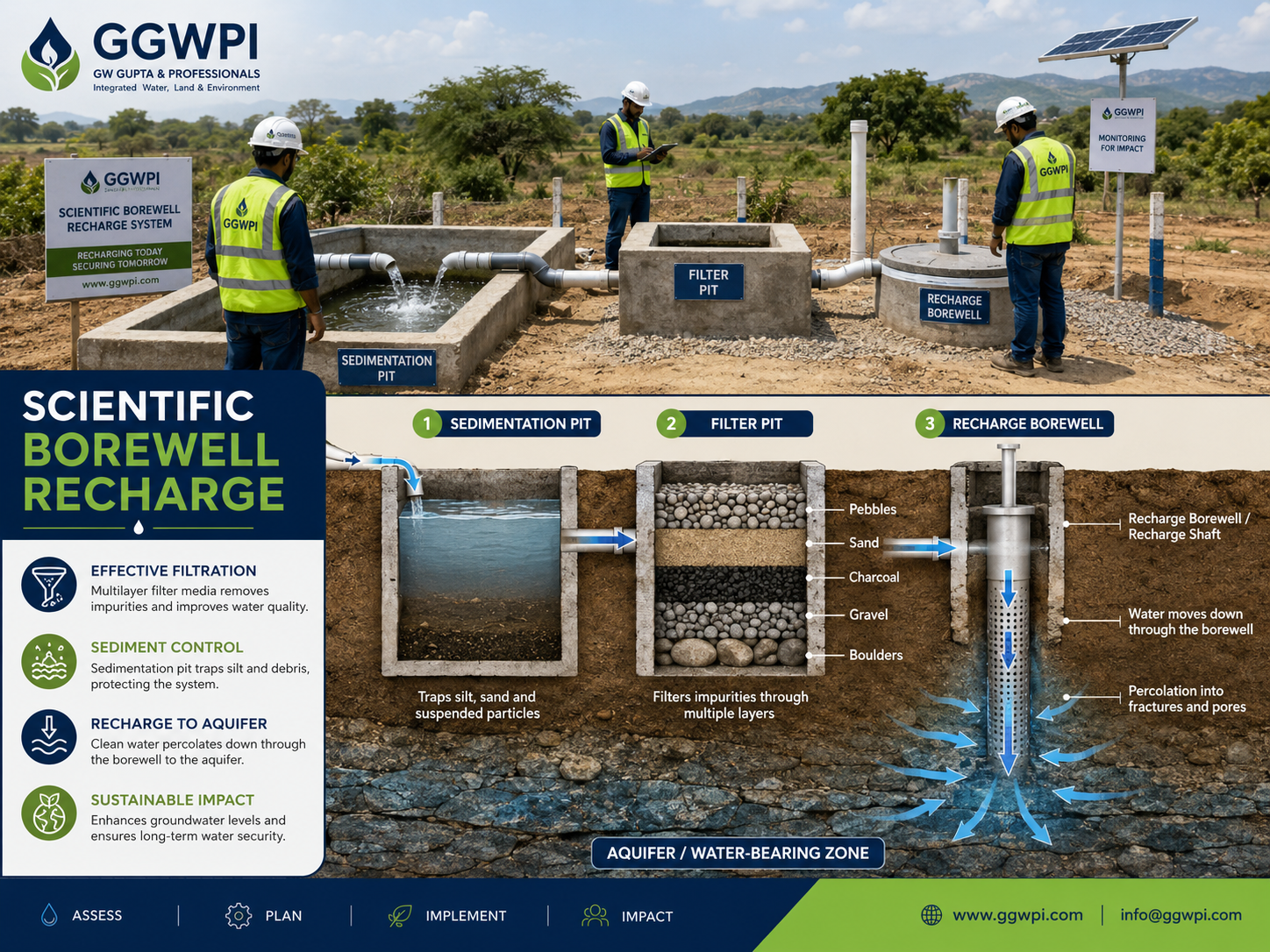
Borewell recharge is a method of directing suitably treated rainwater or surface runoff toward a borewell or specially constructed recharge bore so that water can enter permeable subsurface formations.
The objective is to support groundwater replenishment by using water that might otherwise flow away from the site as uncontrolled runoff.
A recharge system may use:
- An existing inactive or suitable borewell
- A dedicated recharge bore
- A recharge shaft or pit
- A combination of recharge structures
Recharge is site-specific
The appropriate design depends on geology, runoff availability, water quality, borewell condition, available space and the depth and nature of permeable formations.
Why Can Runoff Not Be Sent Directly into a Borewell?
Surface runoff can carry soil, leaves, litter, organic matter, fine sediment, oils and other contaminants. Direct entry can block the recharge pathway, damage the borewell and create water-quality risks.
Sediment and suspended material can:
- Clog filter media
- Block borewell slots or fractures
- Reduce recharge capacity
- Increase turbidity
- Carry contaminants into the subsurface
- Make maintenance difficult and expensive
A recharge system is not a waste-disposal system
Sewage, industrial wastewater, chemically contaminated water or heavily polluted runoff must not be introduced into a groundwater recharge structure.
Main Components of a Scientific Recharge System
How Does the Complete System Work?
Runoff Collection
Water from the approved catchment is directed toward the recharge system.
Sediment Control
Flow enters a chamber where silt and heavier particles are allowed to settle.
Filtration
Water passes through selected filter layers that retain suspended material.
Recharge Transfer
Filtered water is conveyed toward the recharge bore or permeable subsurface formation.
Overflow Management
Excess flow is safely diverted when rainfall exceeds the designed system capacity.
Inspection and Cleaning
Chambers and filter media are inspected and maintained to preserve performance.
What Should Be Checked Before Designing the System?
A successful recharge system begins with an assessment of the water source, site conditions and receiving formation.
Important considerations include:
- Catchment area and runoff volume
- Rainfall intensity and seasonal distribution
- Runoff-water quality
- Existing drainage pattern
- Available space and ground levels
- Soil and geological conditions
- Groundwater level and aquifer characteristics
- Existing borewell depth, diameter and condition
- Distance from septic tanks or contamination sources
- Availability of safe overflow routing
A hydrogeological or resistivity assessment may be useful where the receiving formation or recharge location is uncertain.
Why Maintenance Determines Long-Term Performance
Even a well-designed recharge structure can stop functioning if accumulated silt and debris are not removed.
A practical maintenance programme may include:
- Cleaning collection drains before the monsoon
- Removing silt from settlement chambers
- Checking inlet and outlet pipes
- Inspecting filter-media condition
- Replacing or washing clogged filter layers
- Clearing vegetation and floating debris
- Checking overflow routes
- Monitoring recharge-bore response
- Recording maintenance dates and observations
Pre-monsoon cleaning is essential
The structure should be inspected and cleaned before significant seasonal rainfall begins. Additional cleaning may be required after intense runoff events.
Important Limitations and Risks
Borewell recharge is not appropriate at every site. Poorly designed systems may create contamination, clogging, flooding or structural risks.
Common limitations include:
- Contaminated runoff source
- Highly clayey or impermeable formations
- Damaged or unsuitable existing borewell
- Insufficient separation from pollution sources
- Very high groundwater levels
- Inadequate overflow arrangements
- Poor maintenance access
- Uncontrolled sediment entry
- Incorrect estimation of runoff volume
Applicable local, departmental and groundwater regulations should be reviewed before implementation.
Potential Benefits of a Properly Designed System
Subject to suitable site conditions and maintenance, a scientific recharge system may help:
- Use seasonal runoff more productively
- Reduce uncontrolled surface-water loss
- Support local groundwater replenishment
- Improve water-level recovery over time
- Reduce local waterlogging in selected situations
- Strengthen water-conservation planning
- Complement rainwater-harvesting initiatives
The actual recharge achieved depends on rainfall, catchment, system operation, geology and aquifer acceptance. Performance should be evaluated over multiple rainfall seasons where possible.
Key Takeaway
Effective Recharge Requires Treatment, Design and Maintenance
The purpose of a scientific borewell recharge system is not simply to move runoff underground. It is to collect suitable water, remove sediment, control the flow and transfer it safely toward an appropriate receiving formation.
Long-term performance depends on correct site selection, adequate filtration, safe overflow and regular maintenance.